
KING OF SPADES: the Four pillars of Hip-hop x playing card deck
What would a playing card deck look like if I were to create it? That was the challenge presented to me when Affinity approached me about this commission. We discussed their desire to create something that might translate into a physical project down the road and we landed on a deck of playing cards.
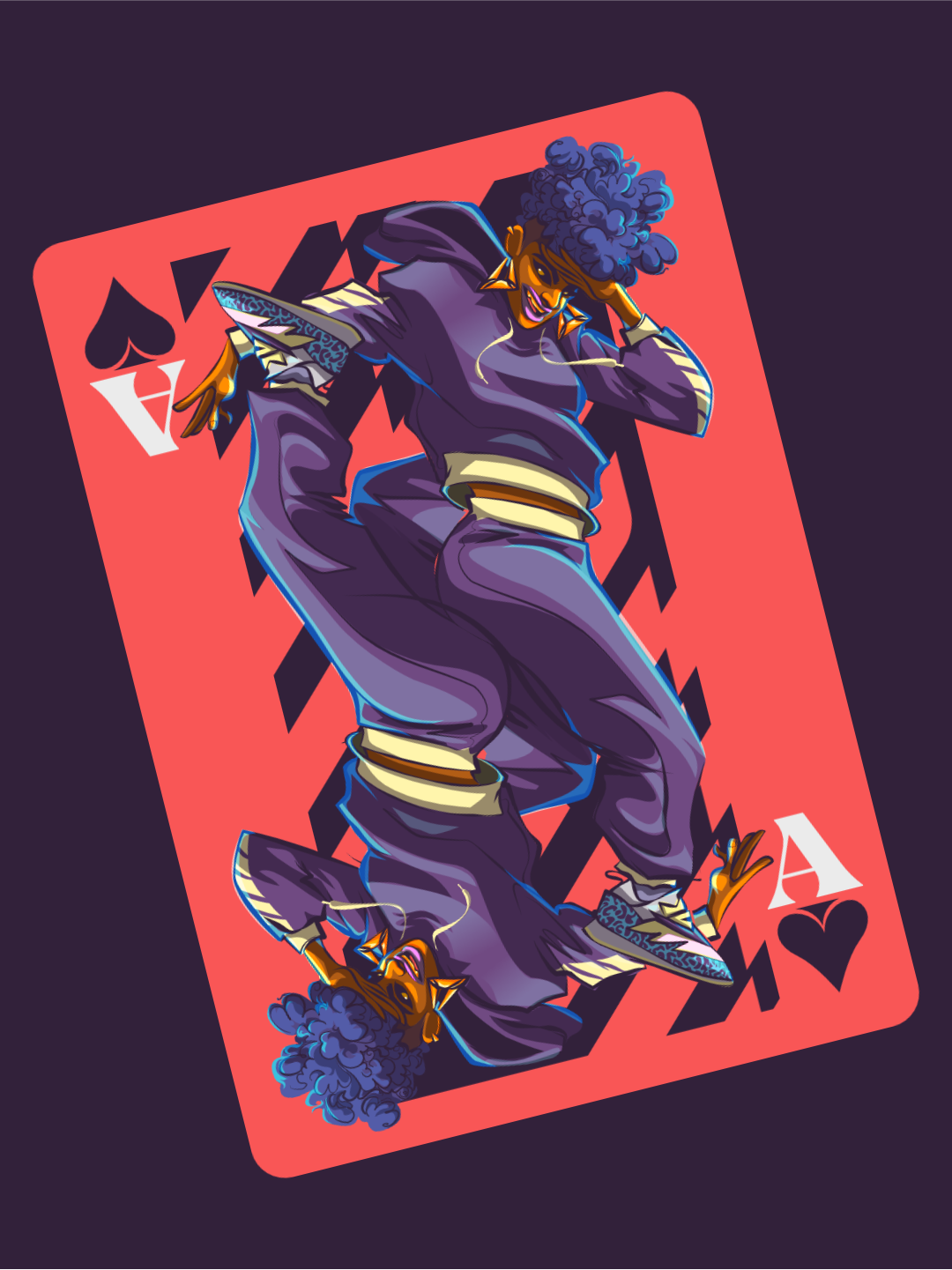
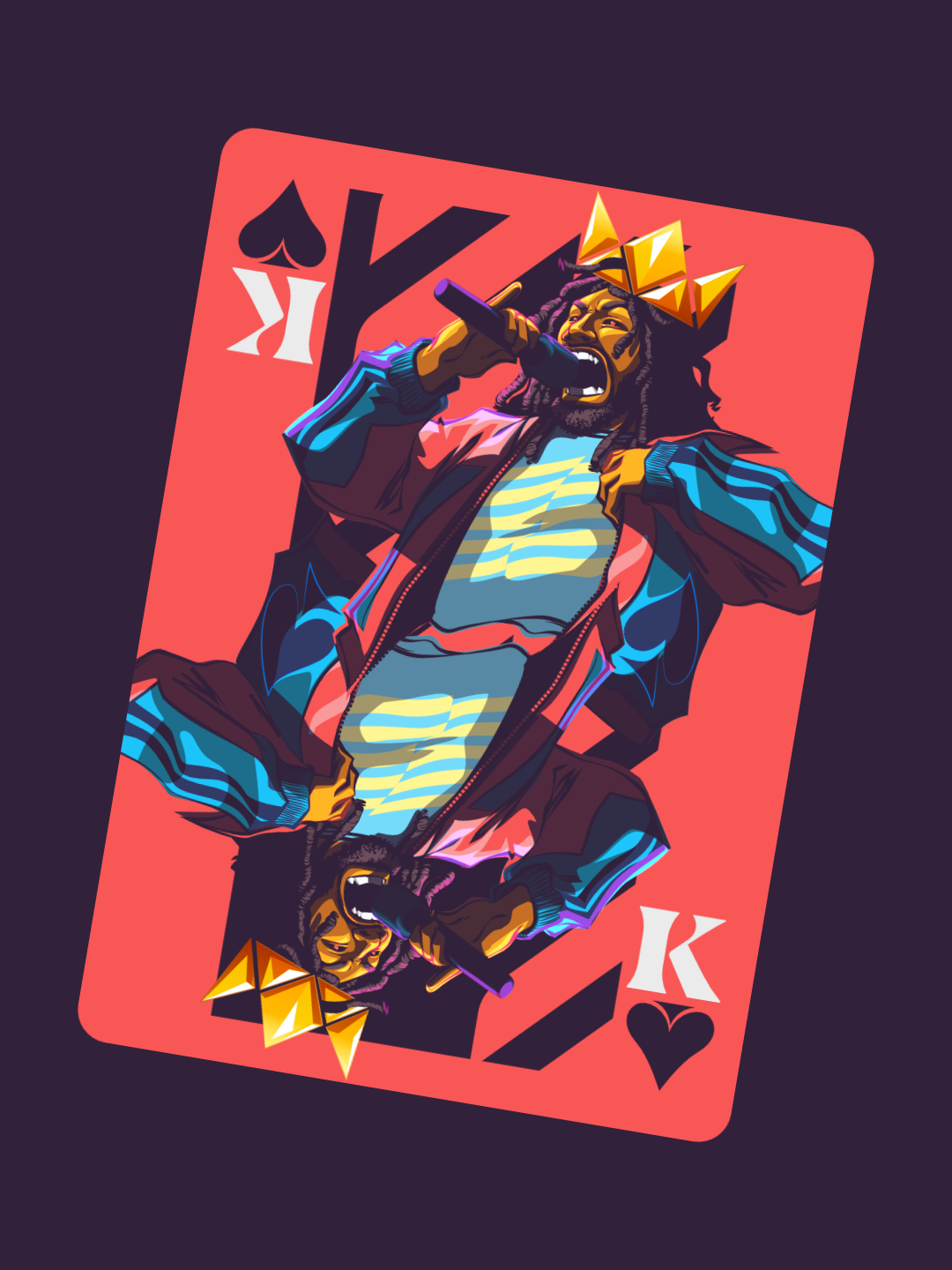
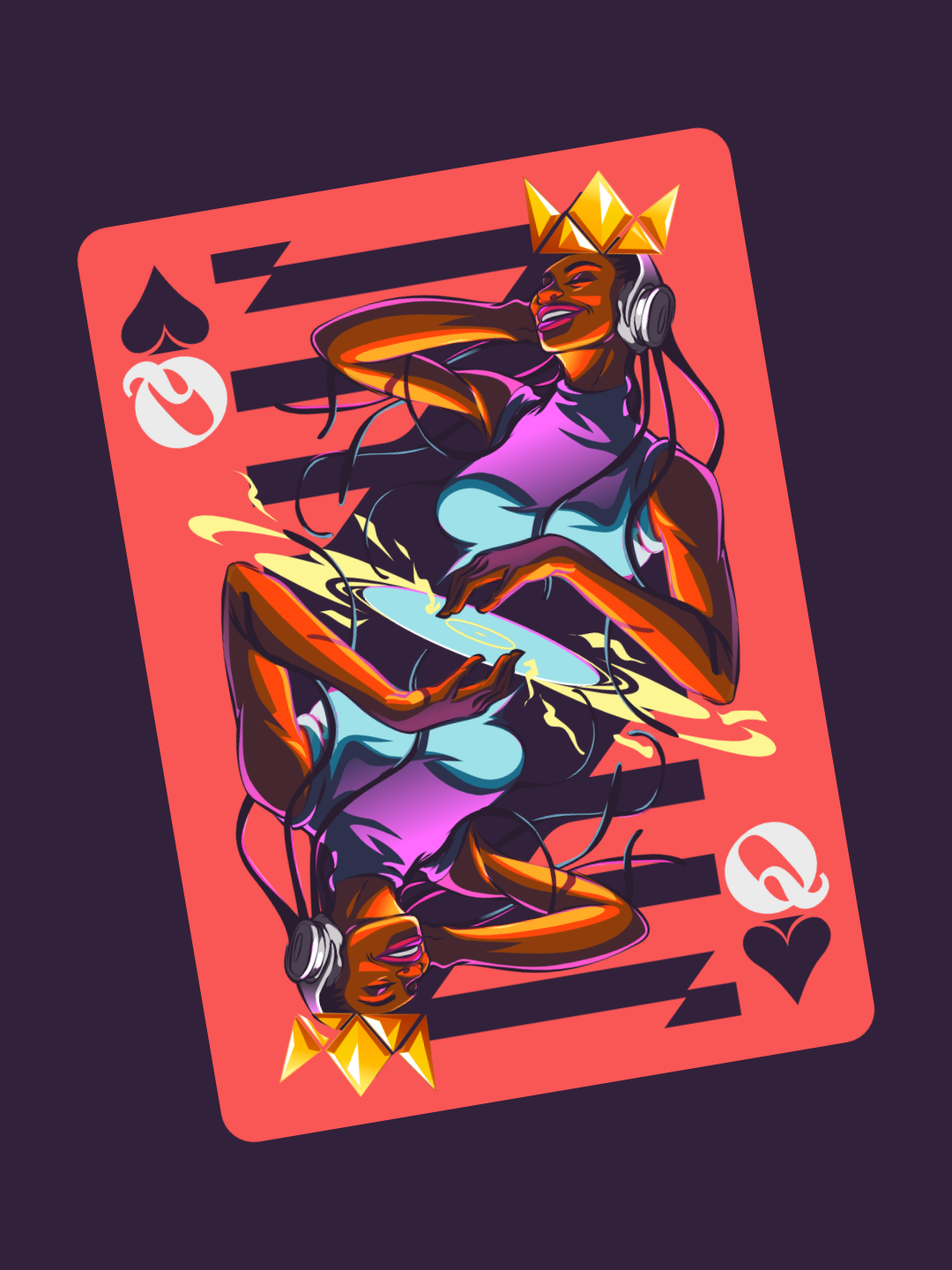
After some consideration I made a short list of themes: Afro futurism, a Hip-hop theme, and a Wakanda inspired Royal family. We discussed sticking to face cards to showcase my illustration work and chose a Royal Flush concept based around the four pillars of Hip-Hop: MC, DJ, Breaking/B-BOY, Graffiti. Each card would represent an individual pillar with one number card, the 10. The team reminded me we would need a design for the back of the card as part of the commission. In total, the project would contain, 4 face cards, 1 number card and a custom back.
If i’m gonna create a series of cards I need to pull some reference to make me more informed on how to make experimental card decks and the frameworks that i need work in. You can see the full mood board here collected on pinterest.
With a solid foundation to build on I got to work sketching out a variety of ideas while debating what is the true nature of a playing card? I developed multiple concepts with a few that functioned more like magazine covers than playing cards. These experiments proved that they wouldn’t function practically and chose function over form. I wanted to go the magazine route, the more I developed the idea, the clearer it became that I needed to let it go and lean into a traditional format for this project. The face cards would flip, making it easy to read no matter how the card was thrown.
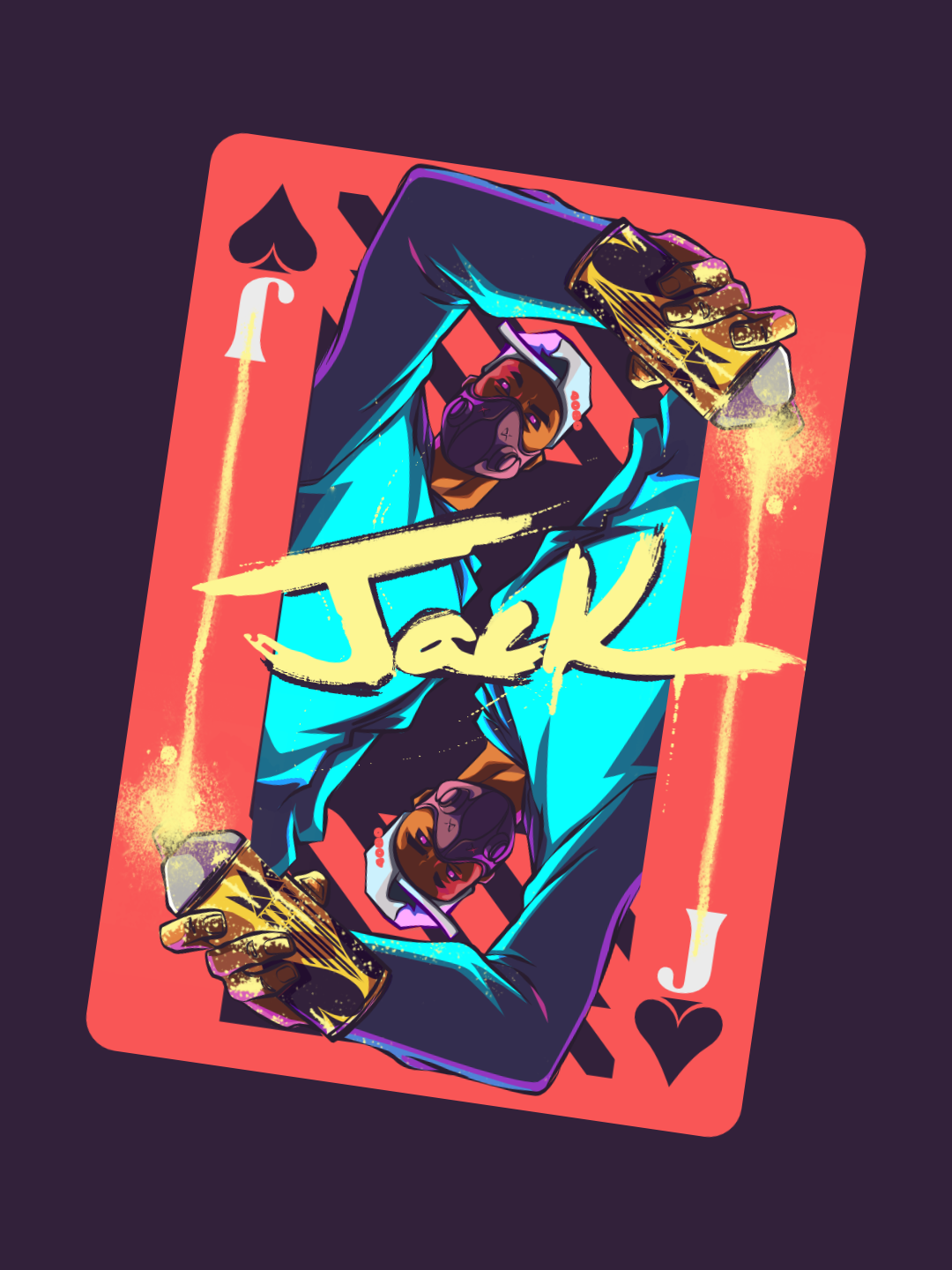
When I started creating the characters for each pillar I had difficulty finding references that had the right angle of the face or positioning of the body that leaned into the structure of a card. Drew Struzman would use himself as the model and add the faces of the subjects he needed. I’ve done this in the past for a few illustrations. Instead of posing as the model I could create what I needed by merging multiple references from a variety of sources. Then I could use those collaged poses as the reference for rounds of sketches to lock down the poses. I had to keep in mind that these poses had to match the pillar, have their own personality plus they would need to interlock once its flipped. This process was used crucial in the DJ and Graffiti cards.
Even the “JACK” title was hand crafted and not a typeface from a foundry. In the 70s & 80s, they didn’t have access to Affinity or desktop publishing apps and created early Hip-Hop flyers used hand-drawn lettering. This was perfect for the graffiti card as it tied directly into the artform. Using one of my Tom Bow markers I took a razor to the nib to break it up to give it more character, James Victore style, and went to work.
After marking up my sketch book, I took a picture, pulled it into Affinity, used the new image trace feature and began to sort through all the ideas. The unpredictability and organic nature that traditional techniques provides adds life to digital illustration where everything is precisely placed.
The initial inked illustrations were working well when flipped and it was time to create the color palette for the project. The color palette was developed while working on the KING card then solidified as I worked my way through the remaining cards. One of the most dominate colors are a rich Red that leans into mid luminosity. If seen on its own it looks dull but becomes vibrant when placed against its counter point a deep moody Purple. These are the core colors of King of Spades. They are accompanied by two secondary colors a dull Yellow and Vibrant blue with a light electric Blue as a highlight. Lastly, there is an off-white to stand out for letters and copy.
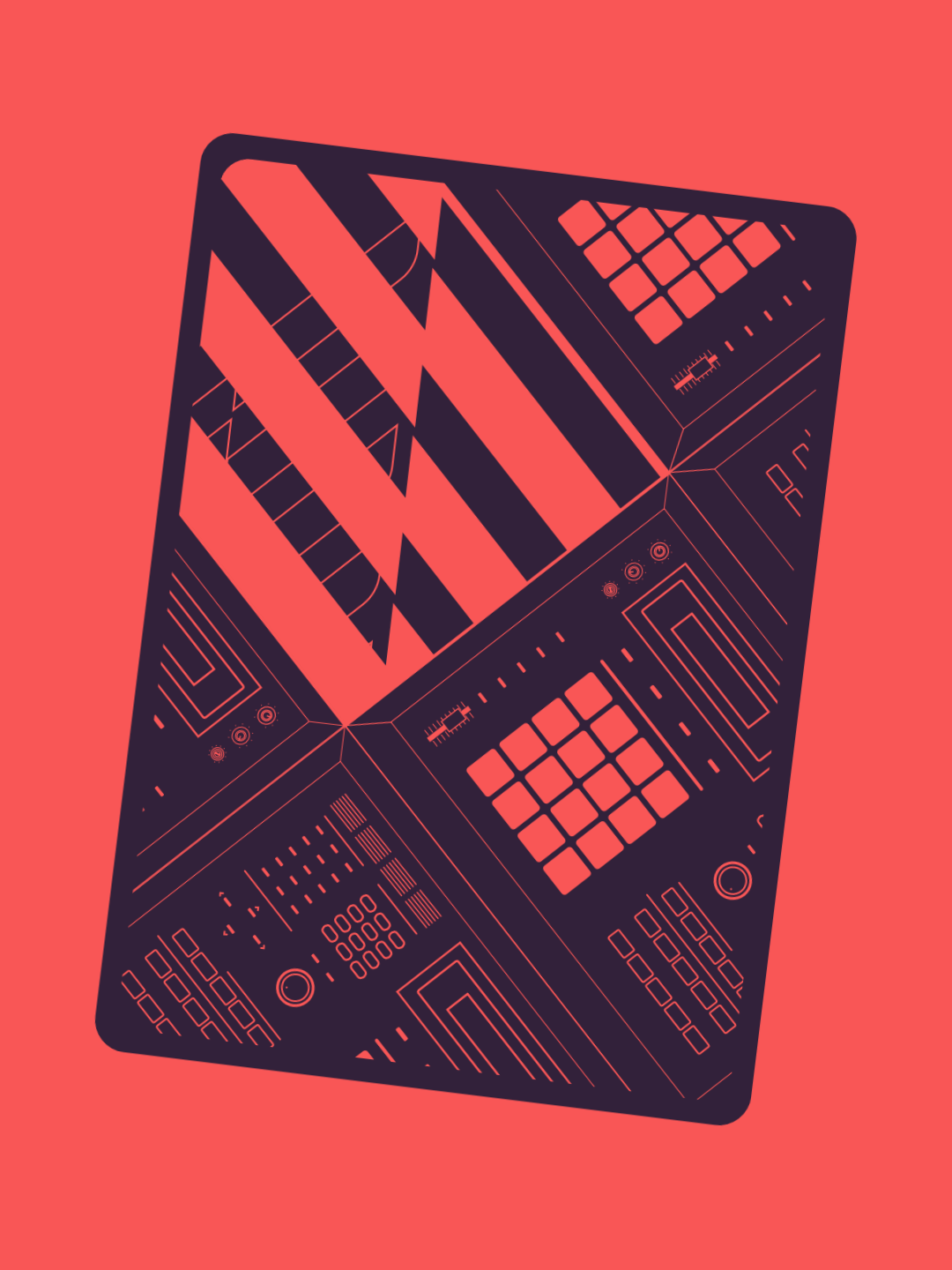
This color palette creates a bold and exciting contrast when combined across the project. The front of the card being Red allows the illustrations, with all its color and energy, to come alive. The back of all the cards are the deep Purple with all the graphics outlined in Red.
The final piece was connecting all the cards including the number and the back of the deck. The number card design fluctuated through out the project. At one point it was dots, then it was bass lines. What I refused to incorporate was a giant mic or record. While I explored those ideas I didn’t want to lean into stereotypical iconography of the genre.
This is why the card has a stylized graphic equalizer for the number card and an MPC for the back of the card. Both visuals are iconic aspects of creating Hip-Hop but not seen as the typical graphic for the genre. The equalizer has reflected the movement of the beat while the MPC is a staple of modern Hip-Hop used by producers. Incorporating this device into the back design acts as the spine that holds the project together the same way producers do for the genre.
King of Spades is built on a simple system: the Four Pillars of Hip-Hop translated into the structure of a Royal Flush. That framework dictated every decision in the project, from composition to iconography.
Choosing a traditional, flipped card format over more experimental layouts ensured the deck functions as intended. That constraint wasn’t limiting, it clarified the work. It forced every illustration, pose, and graphic element to operate within a system rather than exist as a standalone image.
Avoiding cliché Hip-Hop visuals was important. Instead the project leans on tools and elements that are foundational to the culture but less commonly represented. That decision gave the deck a stronger identity while staying rooted in the culture its celebrating.
The result is a collection that works as a cohesive system, not just a set of illustrations. Each card holds on its own, but more importantly, it contributes to a structure that can scale. Expanding this into a full deck isn’t about adding more visuals, it’s about extending the system and pushing it further without breaking what makes it work.

This project was completed entirely in Affinity. You can see how it can fit into your workflow by downloading it for free here.
